



When we think about coding, we should not think only of software developers. Coding skills are used across many different fields, including web and mobile app development, artificial intelligence and machine learning, data science, cybersecurity, game development, robotics, automation, and open-source software. Learning to code therefore means more than simply writing a computer program; it also creates opportunities to participate in the production of the digital world. Although women have made significant contributions to coding and software development for decades, they remain underrepresented and often less visible in these fields.
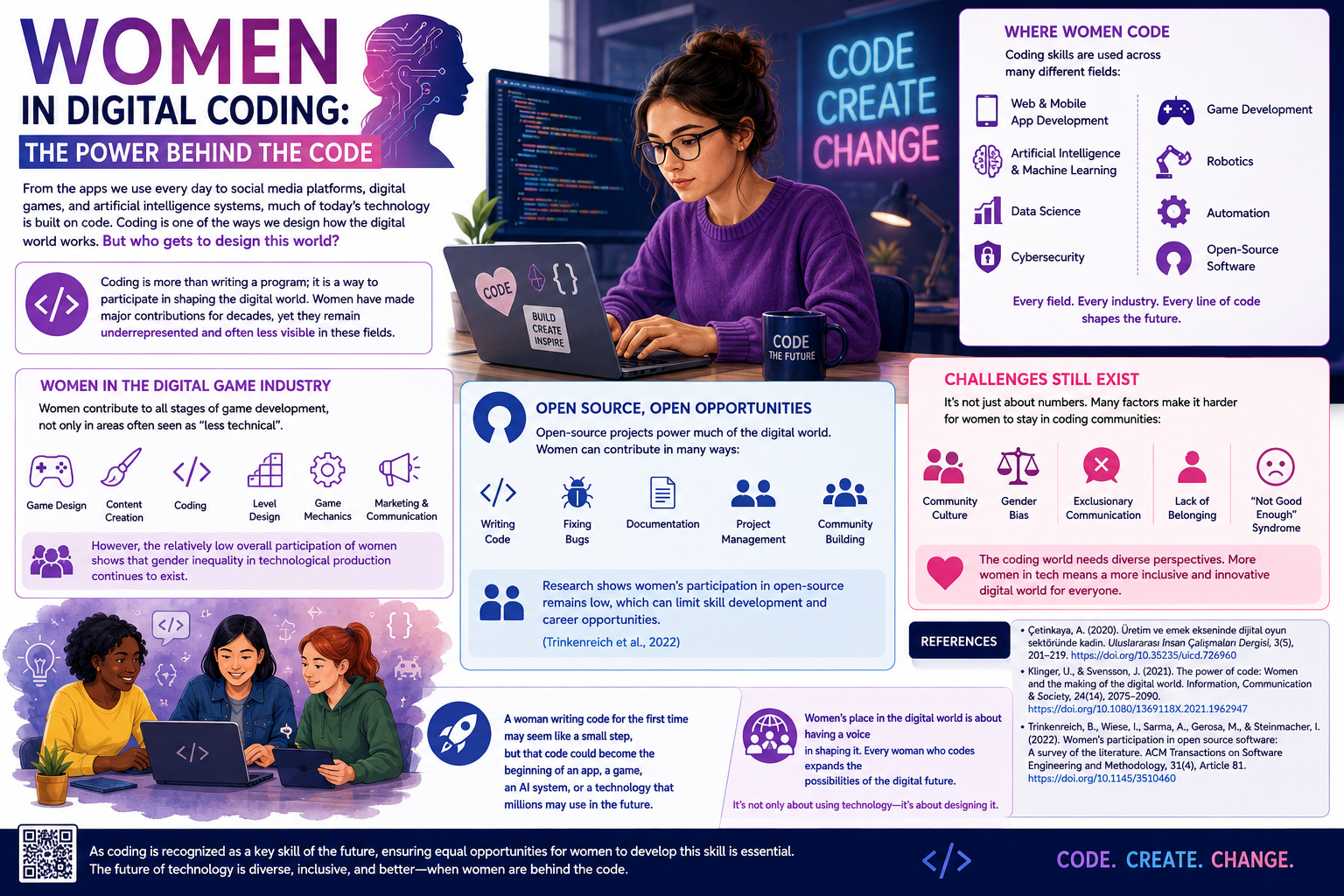
Women’s contributions to these areas are highly diverse. The digital game industry is a particularly interesting example. Çetinkaya’s (2020) study of women game developers in Türkiye shows that women are involved not only in areas that are often perceived as less technical, such as marketing and communication, but also in direct production processes such as game design, content creation, coding, level design, and game mechanics. However, the relatively low overall participation of women in the industry demonstrates that gender inequality in technological production continues to exist.
Women’s contributions to coding are also not limited to commercial technology companies. Open-source software is an important part of the digital world, where people collaborate on projects, develop software, and share their knowledge. Women can contribute in many ways, including writing code, fixing bugs, preparing documentation, managing projects, and supporting the development of communities. Trinkenreich et al.’s (2022) literature review shows that women’s participation in open-source projects remains low, which can limit their opportunities to develop technical skills and build careers in the field.
Moreover, the issue is not simply about the number of women participating. Research suggests that factors such as community culture, gender bias, exclusionary communication, a lack of belonging, and feelings of not being “good enough” can also make it more difficult for women to remain in coding communities. Yet the coding world needs diverse perspectives. Greater participation of women in software development is important not only for increasing women’s employment but also for making the digital world more diverse and inclusive.
As coding continues to be recognized as one of the key skills of the future, ensuring that women have equal opportunities to develop this skill is equally important. A woman writing code for the first time may seem like a small step, but that code could become the beginning of an app, a game, an artificial intelligence system, or a technology that millions of people may use in the future.
Ultimately, women’s place in the digital coding world cannot be explained simply by the idea of having “more women programmers.” The deeper issue is ensuring that women have a voice in shaping the digital world. Every woman who learns to code, develops software, contributes to an open-source project, or creates technology expands the possibilities of the digital future. Because being part of the future of technology is not only about using it—it is also about having the opportunity to design it.
References
Çetinkaya, A. (2020). Üretim ve emek ekseninde dijital oyun sektöründe kadın. Uluslararası İnsan Çalışmaları Dergisi, 3(5), 201–219. https://doi.org/10.35235/uicd.726960
Klinger, U., & Svensson, J. (2021). The power of code: Women and the making of the digital world. Information, Communication & Society, 24(14), 2075–2090. https://doi.org/10.1080/1369118X.2021.1962947
Trinkenreich, B., Wiese, I., Sarma, A., Gerosa, M., & Steinmacher, I. (2022). Women’s participation in open source software: A survey of the literature. ACM Transactions on Software Engineering and Methodology, 31(4), Article 81. https://doi.org/10.1145/3510460