



Women’s place in the history of technology goes back a long way. In the 19th century, Ada Lovelace developed an algorithm that helped her become known as the world’s first computer programmer. Later, Grace Hopper developed a compiler that made computer programs easier to write, while the women who worked on programming ENIAC helped lay the base for modern software. Hedy Lamarr’s work on frequency-hopping communication was also an important step toward the wireless communication systems we use today (Kondhalkar & Kumar Jha, 2025).
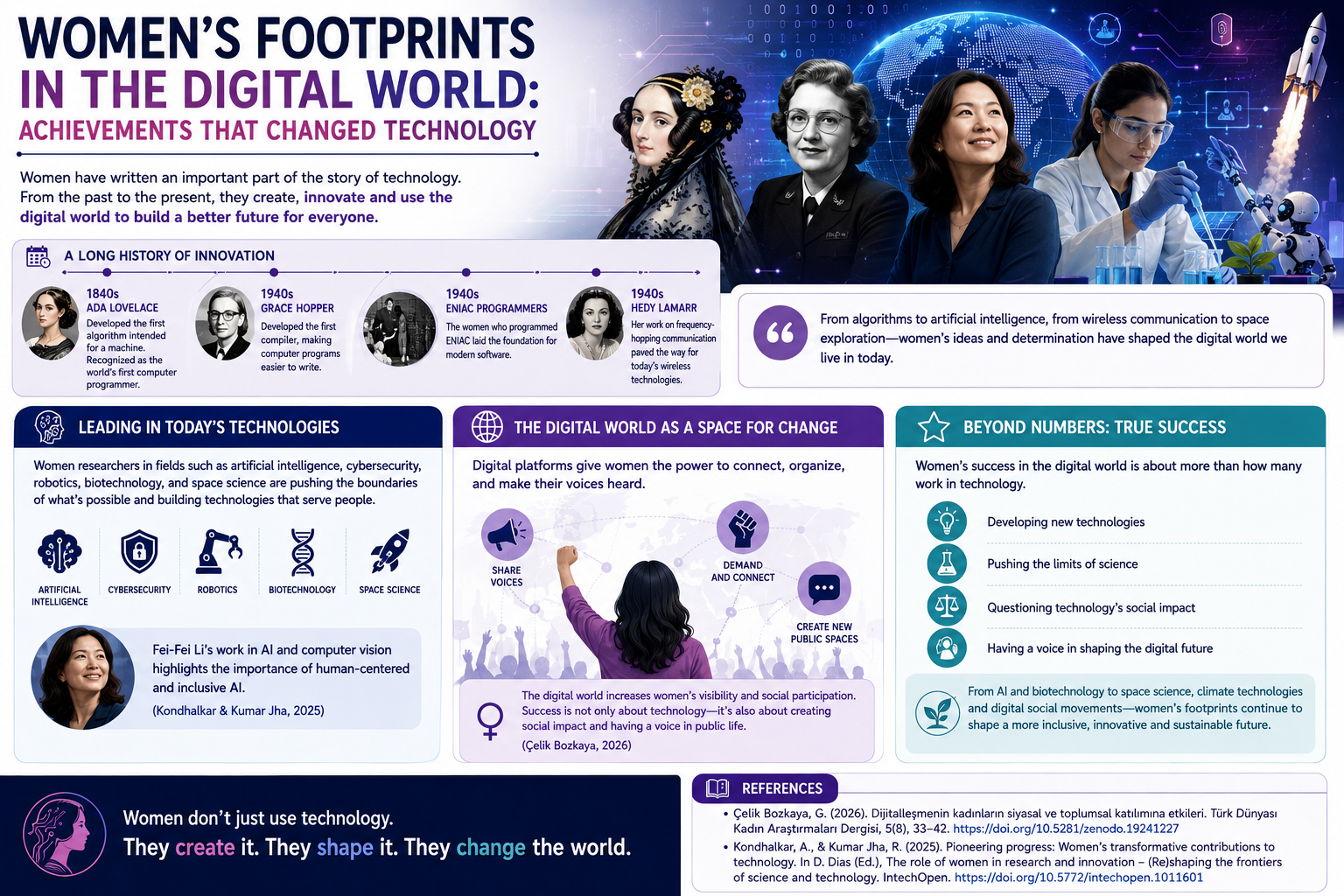
Today, women continue to push the limits of technology. Women researchers working in areas such as artificial intelligence, cybersecurity, robotics, biotechnology, and space science are not only creating new technologies but also offering new ideas about how technology should serve people. For example, Fei-Fei Li’s work in artificial intelligence and computer vision has highlighted the value of human-centered and inclusive AI (Kondhalkar & Kumar Jha, 2025).
Another key impact of the digital world for women is the chance to reach wider audiences. Digital platforms allow women to share their views, express social and political demands, organize around common issues, and create new public spaces. In this way, the digital world is more than a place to access information; it can also increase women’s public visibility and social participation (Çelik Bozkaya, 2026). Women’s success in the digital world is therefore not measured only by scientific or technical work. Their ability to create social change and have a voice in public life is also an important part of this success.
In conclusion, women’s story in the digital world is not limited to a few pioneers. It has spread across many areas of science and technology. From gene-editing technologies and AI to black hole imaging, climate technologies, and digital social movements, women contribute both to the development of technology and to how it is used. For this reason, women’s success in the digital world cannot be measured only by asking, “How many women work in technology?” True success also means developing new technologies, pushing scientific limits, questioning technology’s social impact, and having a voice in shaping the digital future. Women’s place in technology is not only a story of the past; it is an ongoing process that continues to shape the future, from AI and biotechnology to space science and sustainable technology.
References
Çelik Bozkaya, G. (2026). Dijitalleşmenin kadınların siyasal ve toplumsal katılımına etkileri. Türk Dünyası Kadın Araştırmaları Dergisi, 5(8), 33–42. https://doi.org/10.5281/zenodo.19241227
Kondhalkar, A., & Kumar Jha, R. (2025). Pioneering progress: Women’s transformative contributions to technology. In D. Dias (Ed.), The role of women in research and innovation – (Re)shaping the frontiers of science and technology. IntechOpen. https://doi.org/10.5772/intechopen.1011601